


Equipment Manufacturing
Core Optoelectronic Component Manufacturing Project of Baicheng City
1. Introduction to the Project
1.1 Project background
1.1.1 Project introduction
Core optoelectronic components mainly include optical chips, optoelectronic chips, optical devices and optical modules, which are widely used in communication, industry, consumption, lighting and other fields.
(1) Optical chips
Optical chips are the core components in the field of optoelectronics, which can be divided into active optical chips and passive optical chips based on the conversion of the photoelectric signal. Active optical chips include transmitting chips and receiving chips, while passive optical chips include optical switch chips, optical beam splitter chips, etc. Optical chips can also be divided into four categories, namely, InP, GaAs, silicon-based and thin-film lithium niobate according to different material systems and manufacturing processes.
(2) Optoelectronic chips
Optoelectronic chips are the core components of optical devices, which are mainly used to deal with the conversion between optical signals and electrical signals. Common optoelectronic chips include DFB (distributed feedback laser chip), DML (direct modulation laser chip), EML (electrical absorption modulation laser chip). VCSEL (vertical cavity surface emitting laser chip), etc. These chips are widely used in communications, industry and other fields. For example, DFB lasers are suitable for medium and long-distance communications, EML has transmission advantages such as high power and narrow linewidth, while VCSEL is widely used in consumer electronics, industry, automobile and other fields.
(3) Optical devices and optical modules
Optical devices can be divided into active devices and passive devices based on different functions. Active devices are mainly used for photoelectric signal conversion, including lasers, modulators, detectors and integrated devices; passive devices are used to meet other functions in the optical transmission link, including optical connectors, optical isolators, optical splitters, optical switches, etc. By integrating and combining some devices, important components in the optical module, such as TOSA (transmitter optical subassembly) and ROSA (receiver optical subassembly), can be formed to convert information between optoelectronics.
The construction site of the project is located in Jilin Taobei Economic Development Zone, which mainly produces core optoelectronic components such as optical chips, optoelectronic chips, optical devices and optical modules.
1.1.2 Market prospect
(1) Market prospect of optical chips
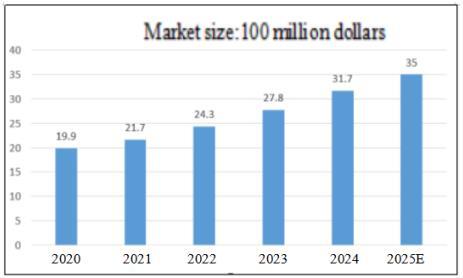
With the rapid development of cloud computing, big data, artificial intelligence and other technologies, the demand for high-speed, high-efficiency and low-energy data transmission is growing, and the market demand for optical chips is also increasing, thus promoting continuous expansion of the global optical chip market. In 2023, the global optical chip market size was about 2.78 billion dollars, increased by 14.4% over the previous year; and the global optical chip market size is expected to reach 3.5 billion dollars in 2025.
Table 1 Global Optical Chip Market Size From 2020 to 2025
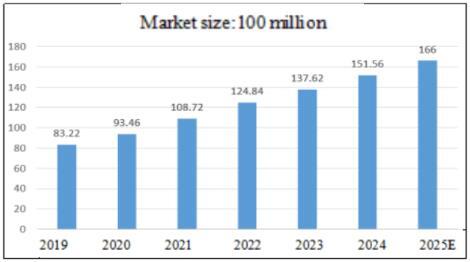
With the acceleration of domestic substitution, China’s optical chip market size continues to grow, showing a strong momentum of development. In 2023, China’s optical chip market size was about 13.762 billion yuan, increased by 10.24% over the previous year; and the global optical chip market size is expected to reach 16.6 billion yuan in 2025.
Table 2 China’s Optical Chip Market Size From 2019 to 2025
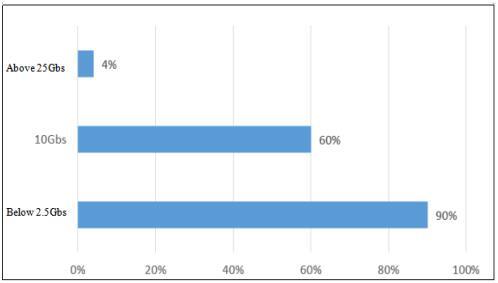
From the perspective of localization rate, related domestic enterprises only master core technologies in the field of 2.5G and 10G optical chips, and the localization rate of optical chips of 2.5G and below exceeds 90%; the localization rate of 10G optical chips is about 60%; and the localization rate of optical chips of 25Gbs and above is low, only 4%.
Table 3 Localization Rate of Optical Chips
The application fields of optical chips are constantly expanding. In the field of sensing, such as environmental monitoring and gas detection, optical chips are used as sensors, which can detect optical signals and convert them into electrical signals for data acquisition and analysis. In the field of automobile, with the electrification and intelligent development of traditional passenger cars, high-level assisted driving technology is gradually popularized, and the application scale of core sensor device laser radar will increase. Optical chips based on gallium arsenide (GaAs) and indium phosphide (InP) are the core components of laser radar, and their market demand will continue to increase in the future.
(2) Market prospect of optoelectronic chips
From a global perspective, with the acceleration of the global informatization process, the amount of communication data is growing explosively, and the demand for optical communication technology is also increasing. The market size of optoelectronic chips, as key components of the optical communication technology, continues to expand with the rapid development of the communication industry. At the same time, the wide application of cloud computing, big data and other technologies has further promoted the growth of the optoelectronic chip market. According to statistics, the global optoelectronic chip market size was 2.7 billion dollars in 2022. It is expected that the global market size will have grown to 5.6 billion dollars by 2027, with a CAGR of 16%, and there is broad room for development.
From the perspective of the domestic market, the development of optoelectronic chips is inseparable from optical communication and optical modules, and the industry is in a stage of accelerated development. With the in-depth implementation of network power strategy, broadband China strategy, major information network projects, etc., China's optical communication industry is developing rapidly, and the demand for optoelectronic chips is also growing. At the same time, the optical module industry has experienced decades of development, and the industrial system of photonic integration technology has been initially formed, which has promoted rapid development of the optoelectronic chip industry. In addition, domestic optoelectronic chip enterprises have made significant progress in technological innovation, product R&D, etc., which has further promoted the expansion of the market size. According to statistics, the market size of China's optoelectronic chip industry has continued to expand since 2017, and the industry market size was be about 10.304 billion yuan in 2023, with a YoY growth by 13.16%.
At present, in the field of optoelectronic chips of 2.5G and below, China’s optoelectronic chip enterprises have basically mastered the core technology, with a high localization rate. In 2021, domestic optoelectronic chips accounted for more than 90% of the global market share in this rate range. However, in terms of high-speed optoelectronic chips, the localization rate was low, and the localization rate of optoelectronic chips above 25G was still low, about 5%, in 2021. As the demand for high computing power grows, the increase in the speed of optical modules has brought about problems such as power loss, which also puts forward higher requirements for the performance of optoelectronic chips. The market of optoelectronic chips of 25G and above will continue to be supported by national policies, the technical level of the industry will continue to improve, and the future development space will be huge. As shown by data, the proportion of optoelectronic chips used in the optical modules above 25G is gradually expanding from 2019 to 2025, and the overall market size will grow from 1,356 million dollars to 4,340 million dollars, with a CAGR of 21.40%.
The application fields of optoelectronic chips are constantly expanding. In the field of sensing, such as environmental monitoring and gas detection, optoelectronic chips are used as sensors, which can detect optical signals and convert them into electrical signals for data acquisition and analysis. In the field of automobile, with the electrification and intelligent development of traditional passenger cars, high-level assisted driving technology is gradually popularized, and the application scale of core sensor device laser radar will increase. Optoelectronic chips based on gallium arsenide (GaAs) and indium phosphide (InP) are the core components of laser radar, and their market demand will continue to increase in the future.
(3) Market prospect of optical devices and optical modules
China's optical device and optical module industry has experienced rapid development in recent years, becoming an important part of the global optical communication industry chain. The market size of China's optical devices and optical modules reached 48 billion yuan in 2023, with a YoY growth by 15%. This growth mainly benefited from the accelerated construction of 5G networks, continued expansion of data centers, and wide adoption of IoT technologies.
China's optical device and optical module market grew significantly faster than the global average in 2023. The market size of China’s optical devices and optical modules is expected to reach RMB 65 billion by 2025, with a compound annual growth rate (CAGR) of about 17%.
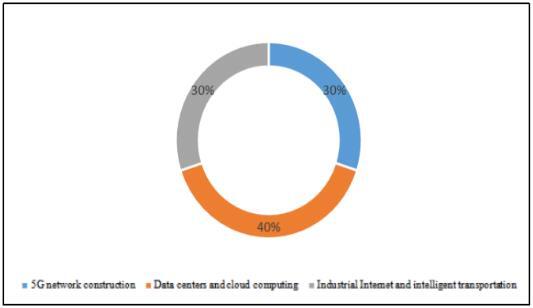
Optical devices and optical modules are mainly used in 5G network construction, data centers, industrial Internet and intelligent transportation. Among them, the market size of 5G-related optical modules reaches RMB 14.4 billion, accounting for 30% of the whole market; the market size of optical modules related to data centers and cloud computing reaches RMB 19.2 billion, accounting for 40% of the whole market; the market size of optical modules in the field of industrial Internet and intelligent transportation reaches RMB 14.4 billion, accounting for 30% of the whole market.
Table 4 Segmentation of Application Fields of Optical Devices and Optical Modules
The technology of China's optical device and optical module industry is developing rapidly, mainly focusing on the following aspects:
① High-speed optical module: With the continuous improvement of 5G and data center requirements for transmission speed, the R&D and application of high-speed optical modules have become the focus. In 2023, 200G and 400G optical modules began large-scale commercial use. It is expected that the market share of 400G optical modules will have exceeded 20% by 2025.
②Miniaturization and integration: In order to meet the needs of equipment miniaturization and integration, the miniaturization and integration technology of optical modules has been constantly improved. In 2023, optical modules with new packaging formats such as QSFP-DD and OSFP gradually became popular, and the market share of these new packaging forms is expected to reach 30% by 2025.
③ Low power consumption and high reliability: In application scenarios such as data centers and 5G base stations, low power consumption and high reliability are key requirements. In 2023, multiple enterprise launched optical module products with low power consumption and high reliability. It is expected that the market share of optical modules with low power consumption will have reached 40% by 2025.
To sum up, the project cooperates with large domestic enterprises in this field to produce core optoelectronic components such as optical chips, optoelectronic chips, optical devices and optical modules, with broad market prospects.
1.1.3 Technical analysis
It is proposed to cooperate with large domestic enterprises in this field. The modern production process and the automated production line are used in the project, and the production process and technology are mature, with large-scale production conditions.
1.1.4 Advantageous conditions of project construction
(1) Policy conditions
In September 2024, the Ministry of Industry and Information Technology issued the Notice on the Guidelines for Equipment Renewal and Technological Transformation in Key Industrial Industries, proposing to focus on the automation, intelligence, flexibility and energy-saving transformation of electronic component and electronic material production and testing equipment, and accelerate the development of electronic components to miniaturization, chip, integration, high frequency, high precision and high reliability, focusing on circuit components, connection components, electromechanical components, sensing components, optical communication devices, key electronic materials and other subdivisions, thus promoting the renewal of major production and testing equipment.
It is proposed in the 14th Five-year Plan for the National Economic and Social Development of Jilin and the Outline of Vision 2035 to promote the high-end development of integrated circuits and the large-scale development of the optoelectronics industry around industries such as “core, optical, satellite, vehicle and network”.
It is pointed out in the 14th Five-year Plan for the Development of Strategic Emerging Industries in Jilin Province to: drive the R&D and production of laser materials, laser equipment, laser devices and other products with technical advantages, promote laser applications, cultivate and introduce a batch of high-tech enterprises in the field of integrated circuits, constantly expand and improve the upstream and downstream industrial chains, and radiate and drive the development of related industries.
It is clearly proposed in the 14th Five-year Plan for Industrial Development of Jilin Province to expand the electronic information manufacturing industry based on optoelectronics, automotive electronics and new components.
It was emphasized in the 14th Five-year Plan for the National Economic and Social Development of Baicheng City and the Outline of Vision 2035 to “strengthen the construction of industrial basic capacity such as core basic components and advanced basic technology”.
(2) Resource advantages
Land advantages. More than 85% of the land in the new industrial park is state-owned, with flat terrain, sufficient land resource reserves, and huge development space.
Energy advantages. Taobei District is committed to building a pilot area for the development and utilization of clean energy in the province, with two thermal power plants in the district, including 2*660,000 kW of CPI and 2*200,000 kW of Guodian Longhua, as well as 3 wind farms, with a total installed capacity of 1.97 million kW and an annual abundant power of 8.42 billion kWh.
(3) Industrial advantages
Jilin Province has a batch of outstanding scientific research achievements in the fields of optical display, spectroscopy technology, high-power semiconductor laser technology, optical communication, microelectronic special equipment, basic materials and devices. Among them, the technical level of most achievements has reached or exceeded the domestic leading level. Universities, scientific research institutes and optoelectronics enterprises in Jilin Province have successively undertaken many projects such as “973 Program Project”, “863 Program Project”, National New Product Program and National Torch Program. Enterprises represented by Jilin Huawei, Changchun New Industry, Yuheng Optics, etc. have become leading enterprises in the fields of power semiconductor discrete devices, all-solid-state semiconductor lasers, photoelectric encoders, etc. in China. Driven by the radiation of leading enterprises, the sales volume of semiconductor lasers, photoelectric encoders and other optoelectronic devices has increased steadily, and photoelectric encoder manufacturers have maintained their leading position in China, with the production and sales rate of products reaching more than 97%; the market share of electronic special equipment and laser medical beauty equipment products continues to increase, and the domestic market share of self-developed component production equipment exceeds 70%. Strong policy guidance and industrial cluster advantages provide important support for the layout of optoelectronics and electronic components and materials in the region.
(4) Talent advantages
Baicheng City has established a total of 12 national-level R&D centers (bases), 6 provincial and municipal independent scientific research institutions, 26 private scientific research institutions, 21 enterprise independent research and development institutions, and 10 provincial-level industrial enterprise technology research centers. It has cultivated 8 provincial-level high-tech enterprises, 10 provincial-level scientific and technological innovation enterprises, and 45 scientific and technological enterprises in Jilin Province, established 15 scientific and technological expert courtyards, 5 spark schools and 25 science and technology demonstration parks, and developed 28 science and technology intermediary service institutions.
Baicheng City has established an evaluation and reward mechanism for scientific and technological talents and scientific research achievements. In the past five years, the Municipal Party Committee and the Municipal Government commended 20 scientific and technological personnel with outstanding contributions, and 162 scientific and technological achievements won the national, provincial and municipal scientific and technological progress awards. It has cultivated a number of top-notch talents, and a large number of young scientific and technological talents have become the backbone of the development of science and technology, with more than 62,000 technicians in the city.
(5) Location and transportation advantages
Jilin Taobei Economic Development Zone is located at the place of the Baicheng Municipal Party Committee and Municipal Government, and is the political, economic and cultural center of the city. It is located in the east of Baicheng City, with convenient transportation and accessible highways and railways. There are Hunwu and Nendan expressways passing through the area; it is 1.5 kilometers away from the railway station and 20 kilometers away from Baicheng Chang'an Airport, with direct flight to Beijing, Tianjin and other places.
1.2 Contents and scale of project construction
The project covers an area of 50,000 square meters, with supporting facilities such as production workshops, assembly workshops, R&D centers, warehouses and office complexes constructed. The optoelectronic component production line is introduced, and core optoelectronic component products are produced.
1.3 Total investment of the project and capital raising
1.3.1 Total investment of the project
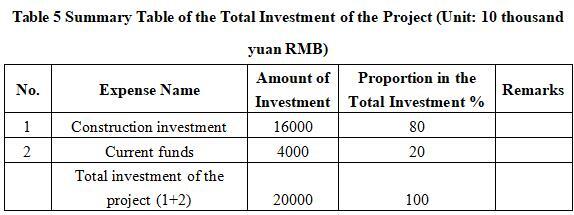
The total investment of the project is 200 million yuan, including the construction investment of 160 million yuan, and the current funds of 40 million yuan.
1.3.2 Capital raising
Self-raised by the enterprise
1.4 Financial analysis and social evaluation
1.4.1 Main financial indexes
After the project reaches the production capacity, its annual sales income will be 144,300,000 yuan, its profit will be 47,620,000 yuan, its investment payback period will be 6.2 years (after the tax, including the construction period of 2 years), and its investment profit rate will be 23.8%.
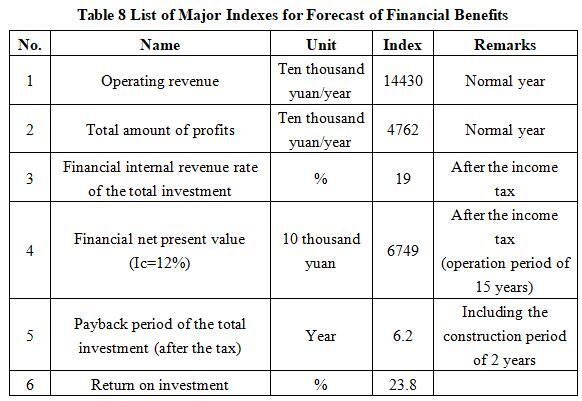
Note: "10 thousand yuan" in the table is in RMB.
1.4.2 Social evaluation
After the completion of the project, it will not only help to solve the problem of “bottleneck” in the key core of the optoelectronics industry, improve the ability to produce and innovate optoelectronics and electronic components, but also drive local employment, play a good role in promoting the development of local society, and also play a good role in promoting the economic development of Baicheng City.
1.5 Cooperative way
Joint venture and cooperation, other methods can be discussed in person.
1.6 What to be invested by the foreign party
Funds, other methods can be discussed in person.
1.7 Construction site of the project
Jilin Taobei Economic Development Zone.
1.8 Progress of the project
Attracting foreign investment.
2. Introduction to the Partner
2.1 Basic information
Name: Jilin Taobei Economic Development Zone.
Address: 5555, Caoyuan East Road, Taobei District, Baicheng City
2.2 Overview
Established on October 10, 2010, Jilin Taobei Economic Development Zone is located in the junction of Jilin Province, Heilongjiang Province and Inner Mongolia, and situated in the northeastern part of Baicheng City, covering an area of 65.6 km2. It is an economic development platform meticulously created by the committee and government of Taobei District, and is the youngest economic development zone in the province. Jilin Baicheng Taobei Economic Development Zone has been rated as the provincial advanced industrial concentration area for many times in the comprehensive evaluation of 37 industrial concentration area in the province.
Jilin Taobei Economic Development Zone is the last batch of development zones approved by the provincial government, and mature and successful experience of developed areas has been learned during the development and construction, with more reasonable planning, more perfect infrastructure, more supporting functions, and more superior environment, which is more attractive to investors.
In order to give full play to comparative advantages, the Taobei District Party Committee and the District Government have established the “two-wheel drive” development strategy of the Jilin Economic Development Zone, which takes industrialization and urbanization as the driving force for development and promotes the urbanization process with the development of emerging industries, and plans three functional sectors of "new industrial park, modern trade and logistics park, and ecological commercial and residential park". It has formulated an industrial development plan focusing on the development of machinery manufacturing and processing, intensive processing of agricultural and sideline products, biomedical and chemical industries, new materials and modern service industries. Based on the principle of “one district with multiple parks, and dislocation development”, it has planned “one demonstration park” - a national-level clean energy consumption demonstration park; “three industrial bases” - precision forging industry base, wear-resistant material production base in northern China, and small and medium-sized enterprise business incubation base; “six industrial parks” - Sino-Canadian Oatmeal International Industrial Park, Dadongyang Science and Technology Industrial Park, Biochemical Circular Economy Industrial Park, Medical Device Science and Technology Industrial Park, Modern Trade and Logistics Park, and Smart Ecological Commercial and Residential Park.
In accordance with the principles of "high starting point, high-standard planning, high-quality construction, high-efficiency management" and rolling development, the five-phase development plan of the new industrial park has been formulated. The development area of the first and second phases has reached 10 square kilometers, reaching the provincial-level development zone standard of “seven connections and one leveling”, and the carrying capacity of the project has reached more than 20 billion yuan. At the end of Phase V development, the development area will reach 33 square kilometers, accounting for more than 50% of the area of Jilin Taobei Economic Development Zone.
2.3 Contact method
Postal code: 137000
Contact Person: Chu Jianghua
Tel: +86-436-3247740
E-mail: tbqjhj@126.com
Contact method of the city (prefecture) where the project is located:
Contact unit: The Bureau of Commerce of Baicheng City
Contact person: Xu Zengchun
Tel: +86-436-3203010 +86-13894682986
Fax: +86-436-3224565
E-mail: bcjhj07@126.com