


Equipment Manufacturing
3D Printing Intelligent Manufacturing Base Project of Baicheng City
1 Introduction to the Project
1.1 Project background
1.1.1 Project introduction
3D printing (3DP), also known as additive manufacturing technology, refers to a process that uses print heads, nozzles or other printing technologies to manufacture parts or physical objects by means of material buildup, which is usually implemented using digital technology material printers, and is often used to create models in the fields such as mold manufacturing and industrial design.
3D printing is a close combination of information network technology, advanced material technology and digital manufacturing technology, which is an important part of intelligent manufacturing. Compared with the traditional subtractive manufacturing method, additive manufacturing has many advantages such as manufacturing of complex items without increasing costs, product diversification without increasing costs, no need for assembly and zero time delivery. It is especially suitable for the manufacturing of customized parts with complex shapes and the pursuit of lightweight.
With the development of intelligent manufacturing technology, 3D printing has gradually become an important force to promote the cultivation and development of China's new-quality productive force, and its application scenarios are constantly expanding.
This project aims to build a 3D printing intelligent manufacturing base in Baicheng Green Power Industry Demonstration Park, and focuses on the development in the fields such as whole machine equipment, special materials, data software and application services with 3D printing intelligent manufacturing industry as the core.
1.1.2 Market overview
(1) Development of the global 3D printing industry
① Development history of the global 3D printing industry
The global 3D printing industry was born in the early 1980s, and its development can be broadly divided into technology R&D phase, mass production application phase, and business profitability phase.
From 1980 to 1990, as the first phase of the development of the 3D printing industry, 3D printing patents, technologies and prototypes were created in succession. In 1983, Charlse Hull invented the world's first 3D printer prototype with stereo lithography apparatus (SLA), which is known as the father of 3D printing, and various 3D printing technologies and prototypes constantly emerged afterwards.
From 1990 to 2010, as the second phase, Europe and the United States gradually formed 3D printing companies, implementing the transition from the prototype of technology and theory to the manufacturing of 3D printers and products. 3D Systems, Stratasys, EOS and other world-leading enterprises launched 3D printing equipment in succession in this phase, covering the current mainstream technologies such as fused deposition molding (FDM), selective laser sintering (SLS) and metal laser sintering (SLM). In addition, the categories of products made through 3D printing constantly expanded in this phase, and downstream application scenarios increased accordingly.
From 2010 to date, as the third phase, 3D printing industry has ushered in rapid development, and leading enterprises continued to merge and acquire. Stratasys merged with Object in 2012, which is the largest merger in the 3D printing industry. 3D System completed the acquisition of Phenix Systems, Medical Modeling, Bot Object and other companies successively from 2010 to 2016, GE of the United States acquired 3D printing giants, Concept Laser and Arcam in 2016, and the business scale of each leading enterprise witnessed rapid development under merger and reorganization.
② Market size of the global 3D printing industry
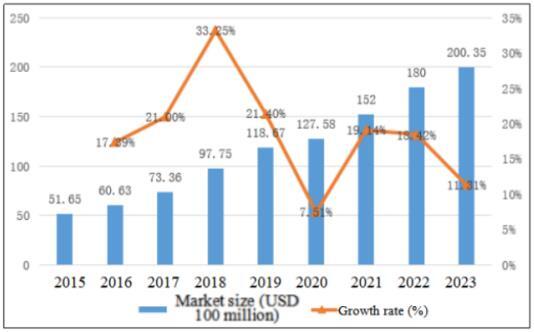
The global printing industry has maintained a fast growth rate since 2010. The market size of global 3D printing reached $12,758 million in 2020, increased by 7.51% compared to that in 2019, lower than the previous growth rate of 21.40%. Layoffs and spending cuts were even more prevalent mainly due to that many companies around the world were affected by epidemic in 2020. Among them, two of the largest companies in the industry, Stratasys and 3D Systems, were the most typical. The share of the two companies in the entire industry was 8.5% in 2020, 10.7% and 13.8% in 2019 and 2018 respectively, showing a downward trend from year to year. It also means that other equipment manufacturers in the industry are on the rise.
The market size of global 3D printing reached $18 billion in 2022, increased by 18.42% compared to that in 2021.
In 2023, the sales volume of global additive manufacturing (3D printing) industry exceeded $20 billion, reaching $20.035 billion, increased by 11.31% compared with that in the previous year. The market size of global 3D printing reached $3.45 billion in the second quarter of 2024, with a YoY growth by 8.4%.
Table 1 Market Size and Growth Rate of Global 3D Printing Industry From 2015 to 2023
③ Market structure of the global 3D printing industry
Judging from the market size and structure of the global 3D printing industry, 3D printing products and 3D printing services accounted for half each. Combined with the market size of the global 3D printing industry in 2022, the market size of 3D printing products and 3D printing services was about $9 billion. This reflects the fact that the use of products in the 3D printing industry still needs to be accompanied by technicians to provide relevant service support. It is a more service-dependent industry as a whole.
④ Main market participants in 3D printing industry around the world
Main suppliers of 3D printing materials around the world are EOS, Hoganas, Sandvik, Solvay, Carbon, 3DSystems and Stratasys, etc., which research, develop and provide different types of 3D printing materials based on R&D capabilities and previous development directions of companies. Among them, the German company, EOS, provides polymer powder, various metal powder, etc. Printing materials account for 30% of the entire sales revenue.
(2) Development of China’s 3D printing industry
① China's industry development history
China's 3D printing industry started behind the international market, and the industry technologies were accumulated before 2016. Various scientific research institutes and universities constantly tried to innovate new technologies and their applications, while more and more enterprises actively laid out to enter the 3D printing industry.
From 2016 to 2019, as the industry's cooling-off period, too high expectations for 3D printing technology led to rapid growth in the number of enterprises in the industry, low-end market areas were saturated, and industrial-grade applications were less than 30%; from 2020 to date, as the rapid industrialization phase, 3D printing technology changed the production mode of the original production end, progressing from the original manufacturing flow to the digital flow.
② Analysis on the industry chain
The upstream of the 3D printing industry chain mainly includes raw material suppliers of core components of 3D printing equipment, software system and 3D printing consumables; the midstream of the 3D printing industry chain includes 3D printing material manufacturers, 3D printing equipment manufacturers and 3D printing service providers; and the downstream of 3D printing covers various application fields, including medical and healthcare, aeronautics and astronautics, construction and building materials, etc.
③ Market size of China’s 3D printing industry
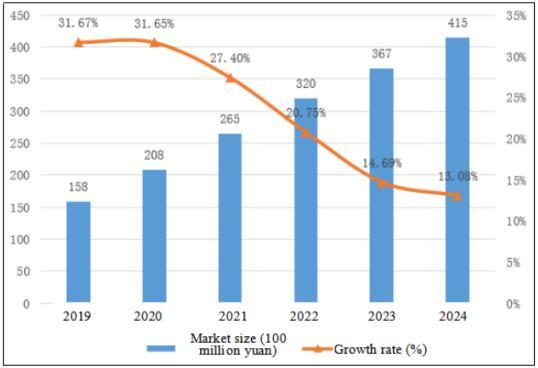
From 2017 to 2020, the scale of China's 3D printing industry increased year by year, and the growth rate was slightly faster than the overall growth rate around the world, so that the proportion of China's 3D industry in the world was constantly increasing.
In recent years, the market size has continued to grow driven by the gradual large-scale application of 3D printing products and the release of some backlog of 3D printing equipment demand. As shown in the 2024-2029 China 3D Printing Market Demand Forecast and Development Trend Prospect Report released by the Zhongshang Industry Research Institute, the market size of China's 3D printing was about 32 billion yuan in 2022, with a YoY growth by 20.75%, and the market size reached 36.7 billion yuan in 2023, the market size reached 41.5 billion yuan in 2024.
Table 2 Market Size and Growth Rate of China's 3D Printing Industry From 2019 to 2024
④ Market structure
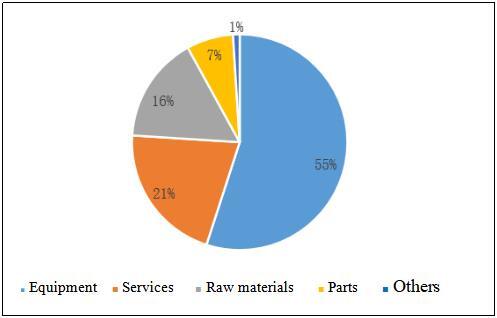
Judging from the industrial structure, the revenue of printing equipment and printing services accounts for the main part in China's 3D printing industry, with equipment revenue accounting for 55% and printing services accounting for 21%. Raw materials and parts account for 16% and 7% respectively.
Table 3 Market Structure of China’s 3D Printing Industry
(3) Project market forecast
The support from Chinese government for the 3D printing industry continues to increase, providing a strong guarantee for industry development. Since 2012, the State Council, the National Development and Reform Commission, the Ministry of Industry and Information Technology, the Ministry of Science and Technology and other departments have successively issued policies to support and standardize the development of the 3D printing industry, which involves the industrialization of 3D printing, development goals, application scope, technological innovation, standards and specifications, etc. In the "14th Five-year Plan" period, the importance of additive manufacturing in China has reached a new level, which has been listed as a key task. The plan emphasizes the need to strengthen breakthroughs in core technologies in key fields China's major provinces have also put forward the development goals of the 3D printing industry, and all provinces and cities have made plans in the upstream materials, midstream equipment services, and downstream application fields of the 3D printing industry.
China's 3D printing industry has shown strong potential in technological innovation. With continuous efforts of domestic scientific research institutions and enterprises, 3D printing technology has made remarkable progress in materials, equipment, software and other aspects. For example, the research and development of high-performance materials such as new polymer materials and metal powders has provided more options for 3D printing and promoted the transformation and upgrading of the manufacturing industry. At the same time, domestic enterprises have also continuously improved the accuracy, speed and stability of 3D printing equipment, making 3D printing technology applied in more fields.
The application scenarios of 3D printing technology in China continue to expand. 3D printing technology plays an important role in traditional fields such as aeronautics and astronautics, medical care and architecture, and emerging fields such as education, entertainment and cultural creativity. Especially in the medical field, 3D printing technology provides strong support for customized medical devices, surgical simulation, etc., and promotes the improvement of medical standards. At the same time, 3D printing technology is also integrated with other technologies such as artificial intelligence and IoT to promote the intelligent development of the manufacturing industry. Such integration and innovation not only enhance the value of 3D printing technology, but also opens up more possibilities for future development of the industry.
To sum up, driven by policies and the market, the 3D printer industry will usher in more development opportunities and challenges, and the future development trend and prospects are broad.
1.1.3 Technical analysis
A scientific research team is established in the project to carry out R&D and innovation in terms of materials and processes of 3D printing with regard to market demands. The modern production process and the automated production line are used in the project, so as to improve the production efficiency and the production quality.
1.1.4 Advantageous conditions of project construction
(1) Policy advantages
3D printing is an important development industry in intelligent manufacturing-related industries. Intelligent manufacturing is the main direction of the construction of a manufacturing power, and its development degree is directly related to the quality level of China's manufacturing industry. In December 2021, 8 departments such as the Ministry of Industry and Information Technology and the National Development and Reform Commission jointly issued the "14th Five-year Plan" for the Development of Intelligent Manufacturing, putting forward key tasks related to 3D printing. Strengthen breakthroughs in core technologies in key fields, and make breakthroughs in advanced process technologies such as additive manufacturing, ultra-precision machining, near-net-shape forming, and molecular-level physical characterization; vigorously develop intelligent manufacturing equipment, and vigorously develop additive manufacturing equipment such as laser/electron beam high-efficiency selective melting equipment as well as laser selective sintering and forming equipment.
In September 2021, it was put forward in the "14th Five-year Plan” for the Development of Electronic Information Industry in Jilin Province to rely on key technologies of the laser industry as owned by universities and institutes, strengthen laser processing equipment and laser communication equipment, and accelerate R&D and industrialization of laser anti-counterfeiting, laser detection, laser medical care, laser cutting and welding, laser additive manufacturing equipment, etc.
(2) Resource advantages
The Baicheng Green Power Industry Demonstration Park, with Taobei Economic Development Zone as the core, and with a planned area of 50 square kilometers, has abundant land resources, and can meet the needs of the project.
With carbon neutrality as the main direction of attack, Baicheng Green Power Industry Demonstration Park adopts the source-grid-load-storage integration model to build a clean energy supply base as the source end of the demonstration park, that is, to integrate wind and solar resources of about 23 million kilowatts within a radius of 100 kilometers with Taobei District as the center to support electricity consumption of the park. At the end of the "14th Five-year Plan" period, Baicheng Green Power Industry Demonstration Park will be developed into a national carbon neutrality demonstration park with clean energy installed capability of more than 5 million kilowatts for local consumption (annual power supply of 12 billion kWh).
(3) Location advantages
Taobei District is located in the northwest of Jilin Province, and at the intersection of Jilin Province, Heilongjiang Province and Inner Mongolia Autonomous Region. The specific location is in the middle of Baicheng City, adjacent to Zhenlai County and Da'an City in the east, and bordered by Taonan City in the west and south. Taobei District is a transportation hub connecting the three provinces, with convenient transportation and low logistics costs.
Taobei District has convenient transportation, with Hunchun-Ulanhot Expressway and Nendan Expressway passing through, only 1.5 kilometers away from the railway station and 20 kilometers away from Baicheng Chang'an Airport. There are direct flights to Beijing, Tianjin and other places.
(4) Talent advantages
Baicheng City has a number of scientific research institutes such as the Agricultural Research Institute, the Forestry Research Institute, the Agricultural Machinery Research Institute and the Animal Husbandry Research Institute, with 40,873 professional technicians, including 6,898 persons with senior titles, 18,409 persons with intermediate titles, and 15,566 persons with primary titles.
In 2023, Baicheng City issued the 20 Measures for Strengthening and Improving the City's Talent Work, aiming to revitalize local talent resources to the maximum limit based on geographical advantages, accelerate the construction of 3 teams, namely, expert strategic talents, practical local talents, and technical blue-collar talents, and provide a strong talent guarantee for comprehensive construction of a new Baicheng with socialist modernization.
1.2 Contents and scale of project construction
The project covers an area of 150,000㎡, with a gross floor area of 148,000 ㎡. The project sets up 4 functional areas, namely, integrated service area, R&D incubation area, industrial acceleration area and warehousing logistics area, and builds 23,000 ㎡ of 3D printing technology business incubator, 100,000 ㎡ of standard factory buildings, and 25,000 ㎡ of supporting facilities.
After the completion of the project, main products involve 3D data modeling and software, 3D printing equipment, consumables and application services, etc., basically building the whole 3D printing industry chain.
1.3 Total investment of the project and capital raising
1.3.1 Total investment of the project
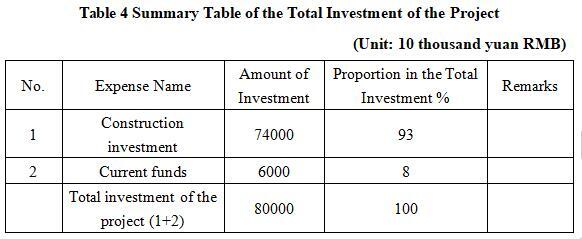
The total investment of the project is 800 million yuan, including the construction investment of 740 million yuan, and the current funds of 60 million yuan.
1.3.2 Capital raising
Self-raised by the enterprise.
1.4 Financial analysis and social evaluation
1.4.1 Main financial indexes
After the project reaches the production capacity, its annual sales income will be 960 million yuan, its profit will be 240 million yuan, its investment payback period will be 6.3 years (after the tax, including the construction period of 3 years), and its investment profit rate will be 30.0%.
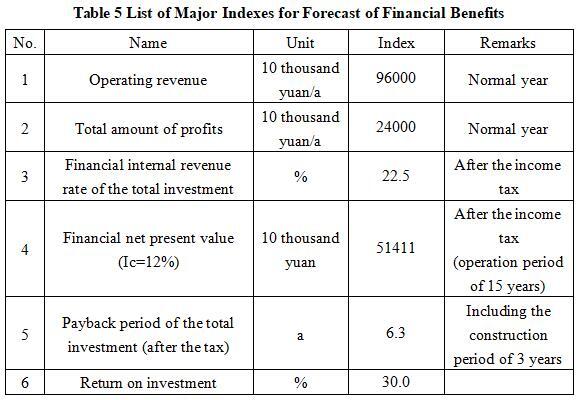
Note: "10 thousand yuan" in the table is in RMB.
1.4.2 Social evaluation
The project construction not only has significant advantages in improving industrial design capabilities, meeting personalized needs, and reducing material waste, but also shows great potential in promoting the transformation and upgrading of the manufacturing industry and promoting new economic growth points. Once completed, the project will promote the upgrading of relevant industries, drive the development of upstream and downstream industries, solve the problem with surrounding labor employment, increase local fiscal revenue, and have good economic and social benefits.
1.5 Cooperative way
Sole proprietorship.
1.6 What to be invested by the foreign party
Funds, equipment and technology.
1.7 Construction site of the project
Baicheng Green Power Industry Demonstration Park.
1.8 Progress of the project
The project proposal has been prepared.
2. Introduction to the Partner
2.1 Basic information
Name: Taobei District Project Service Center
Address: 14 Youth South Street, Taobei District, Baicheng City
2.2 Overview
Established on October 10, 2010, Baicheng Taobei Economic Development Zone is located in the junction of Jilin Province, Heilongjiang Province and Inner Mongolia, and situated in the northeastern part of Baicheng City, covering an area of 65.6 km2. It is an economic development platform meticulously created by the committee and government of Taobei District, and is the youngest economic development zone in the province. Baicheng Taobei Economic Development Zone has obvious and unique comparative advantages, and has been rated as the provincial advanced industrial concentration area for many times in the comprehensive evaluation of 37 industrial concentration area in the province.
Taking carbon neutrality as the main direction of attack and with Taobei Economic Development Zone as the support, Baicheng Green Power Industry Demonstration Park integrates chemical parks in Baicheng Industrial Park, and creates seven industrial parks, such as green new materials, green metallurgy, green equipment manufacturing, green big data intelligent management, green food and medicine and health, green hydrogen, and green chemical industry. At the end of the "14th Five-year Plan" period, Baicheng Green Power Industrial Demonstration Park will be developed into a national carbon neutrality demonstration park with clean energy installed capability of more than 5 million kilowatts for local consumption (annual power supply of 12 billion kWh), investment in fixed assets of 20 billion yuan and output scale of 20 billion yuan, thus becoming a new engine for high-quality development of ecological economy in the western region of Jilin Province.
2.3 Contact method
2.3.1 Contact method of cooperator
Contact unit: Taobei District Project Service Center
Contact Person: Chu Jianghua and Zhai Jiayu
Tel: +86-436-3247740
E-mail: tbqjhj@126.com
2.3.2 Contact method of the city (prefecture) where the project is located
Contact unit: The Bureau of Commerce of Baicheng City
Contact person: Xu Zengchun
Tel: +86-436-3203010
+86-13894682986
E-mail: bcjhj07@126.com